Configuration System Overview
The new configuration system introduced in UNIFYConnect v6 replaces the previous, XML-based configuration system. It provides better type-safety, improved null-value handling and enables the new external configuration value store feature. Configuration files are now JSON based, and a mechanism for migrating legacy XML configuration to new new format exists and can be extended for connectors and agents.
This set of documentation covers the new configuration system, focusing on its used by connector plug-ins.
Basic Usage in Connector Plug-Ins
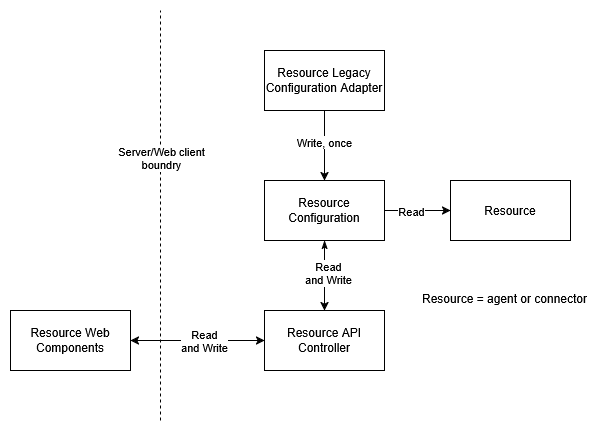
The above diagram outlines the flow of configuration data in a connector or agent, or more specifically, the flow that needs to be implemented and managed by the connector plug-in code. UNIFYConnect connector and agent information exposes a Extended property of type IConfigObject which can be populated with any configuration values specific to that kind of connector/agent.
Connector and agent plug-ins require an extended API information factory and agent to be implemented, which converts extended configuration to and from the API models that represent this configuration.
For a more in-depth explanation on the basic usage of the configuration system, see Basic Usage.
For information relating to legacy configuration adapters and how to create them, see Legacy Extended Configuration Adapter.
Supporting External Configuration References
The configuration system allows configuration values to be referenced from the External Configuration System, however the configuration values must be handled in a way that supports this. For a full breakdown on how to achieve this and why it is necessary, see Supporting External Configuration References.