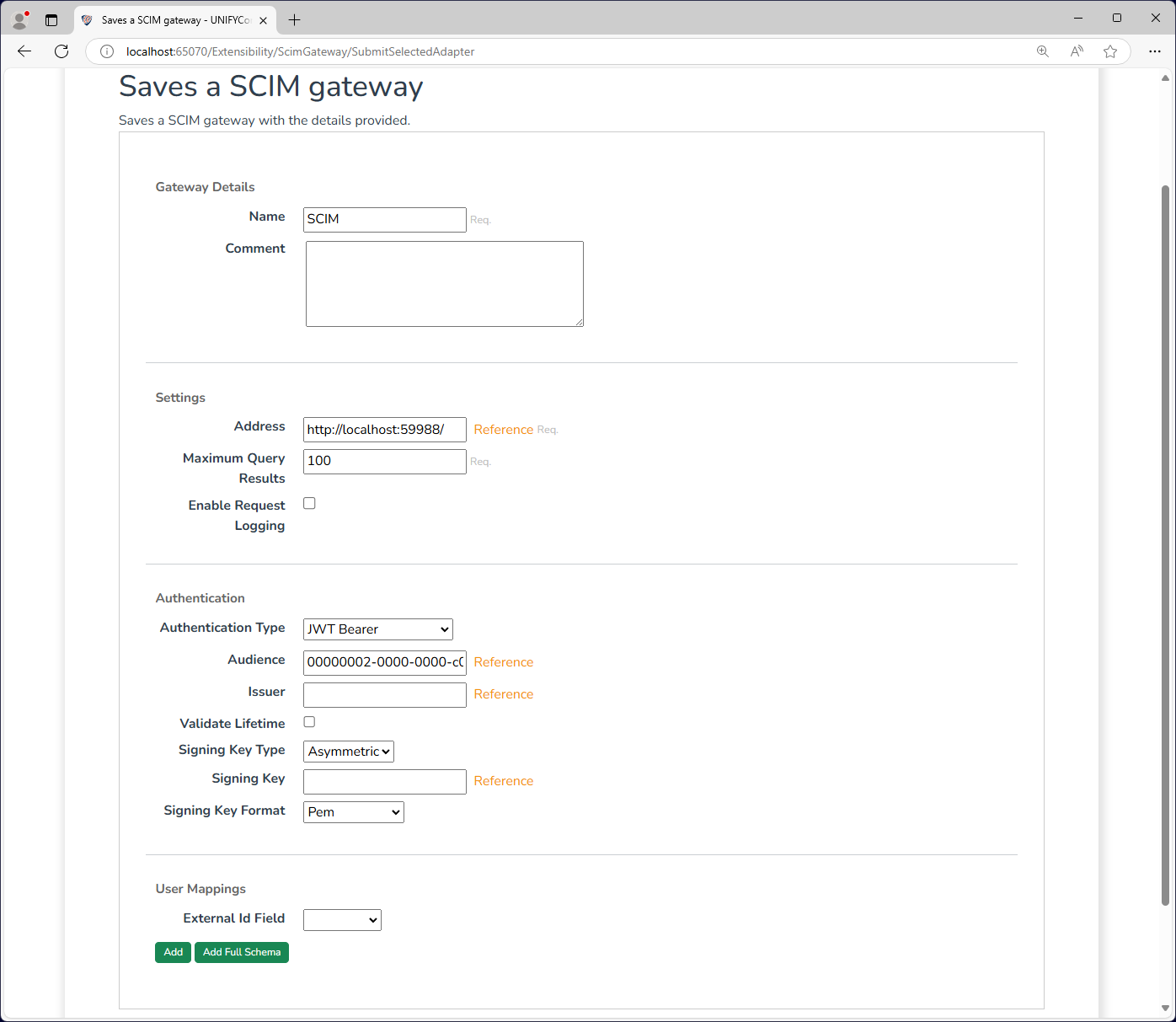
JWT Bearer Authentication
This authentication scheme expects incoming requests to have an JWT Bearer token in their Authorization header.The header should be similar to this example:
jwt
Authorization: Bearer <secret token>Configuration
| Name | Supports References | Description |
|---|---|---|
| Audience | yes | If provided, JWT tokens must contain this value as its aud claim to be considered valid. |
| Issuer | yes | If provided, JWT tokens must contain this value as its iss claim to be considered valid. |
| Validate Lifetime | no | Whether the iat (issued at) and nbf (not before) claims should be validated. |
| Signing Key Type | no | If a signing key should be used to validate the authenticity of the JWT token. Signing key validation of either type is recommended. |
| Signing Key | yes | The signing key the used to validate the signature of the token. See below for the requirements of the signing key, depending on the selected Key Type |
| Signing Key Format | No | The format of the signing key. See Signing Key Types below for the formats supported for each type. |
Signing Key Types
| Key Type | Requirements |
|---|---|
| Symmetric | The key used by the request sender to sign the JWT token. Can be provided in base64 or UTF8 encoding.NOTE: Only symmetric keys meeting the recommended minimum length for the signing algorithm are supported (ie 256 bits/32 bytes for HmacSha256, 384 bits/48 byts for HmacSha384, 512 bits/64 bytes for HmacSha512, etc). JWT tokens signed with a symmetric key that does not meet this requirement will not be considered valid. |
| Asymmetric | The RSA public key, corresponding to the private key used to sign the JWT token by the sender. Must be provided as either an X509 SubjectPublicKey or a PKCS#1 RSAPublicKey, with or without PEM headers. |